System Architecture
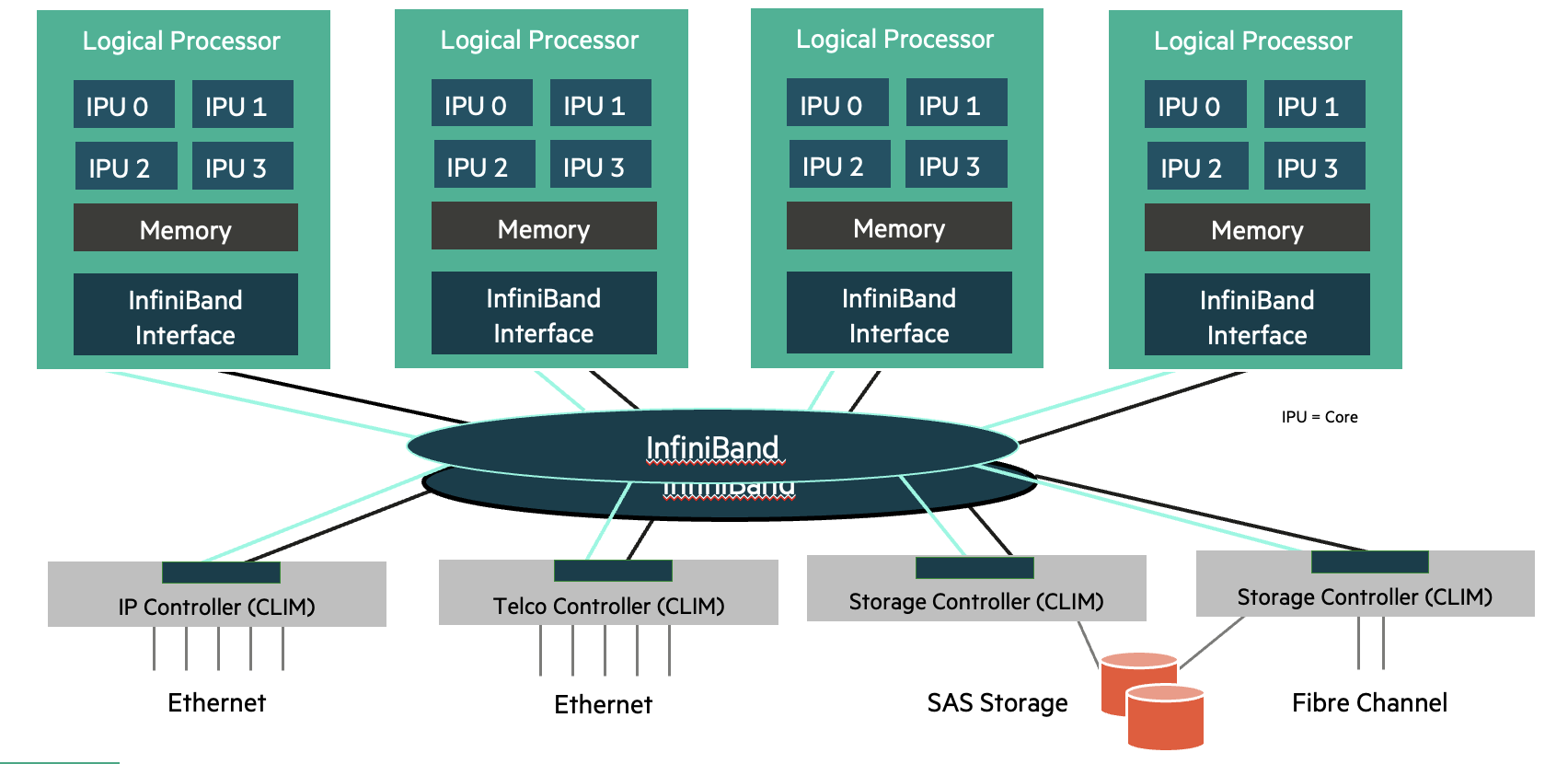
In the market today, a variety of hardware platforms run an even more diverse range of operating systems, and aside from a few other vendors, most hardware and software pieces seldom come from the same vendor. HPE NonStop's tight hardware and software integration enables fault-tolerance and its self-healing capabilities to be consistent throughout its hardware and software components.
Clusters vs NonStop's Fault Tolerance
Quality servers with RAID (redundant array of independent disks) arrays is one of the ways to provide basic fault tolerance to storage. However this level of fault tolerance is often insufficient for most applications - hence the invention of clusters.
Clusters are a set of tightly coupled servers and systems sharing resources, to protect mission-critical workloads from certain failures. Clustering is a complex task - requiring meticulous load balancing and fine tuning, especially with syncronous data between individual systems.
NonStop's hardware reinforces redundancy to the extreme, providing effectively 100 percent uptime - every hardware component on the NonStop system is duplicated. This means that there is at least two storage units, two processors and two RAM busses.
Self-Healing Software
From a high-level overview, the HPE NonStop system can be described as a self-managing, self-healing cluster in one OS image. This is possible because of the shared nothing architecture, preventing malware and viruses from spreading between the components of the systems.
Critical operating system processes run in what is called process pairs in over two CPUs, allowing the processes to survive failures of any one particular CPU.
Because of the design, the software is able to transparently fail-over over to the second set of components without interrupting existing operations.
NonStop TS/MP - Transaction Services / Massively Parallel
Under the hood, HPE NonStop Pathway with TS/MP software provides the application server functionality to develop and deploy business-critical online transaction processing (OLTP) applications on HPE NonStop X servers.
TS/MP allows developers to focus on implementing and refining business logic without having to be concerned about common application services such as:
- Load balancing
- Communications I/O
- Memory management
- Fault tolerance
- Threading and scheduling
The module supports applications written in C/C++, COBOL, Java and TAL, and is used internally by many NonStop products to inherit the platform's high availability and fault tolerance characteristics.